Showing posts with label autism functioning levels. Show all posts

Real World Autism Functioning Levels and Conor's Hospital Adventure


Dr.Everett Chalmers Hospital, 
Fredericton, New Brunswick

One of the many controversies that mark discussions of autism disorders is the question of functioning levels.  Some high functioning persons with autism and Aspergers object to the notions of low and high functioning autism.  Those who  claim that a reference to low functioning autism is not founded in "science" do not provide any credible scientific authority for their beliefs. Nor do they usually make reference to daily real life situations of the kind experienced this week by my severely autistic, low functioning son Conor.  Conor had to undergo dental procedures at the Dr. Everett Chalmers Hospital, the "DECH" as it is often described locally,  and he did very well throughout the process. The fact though that he had to be placed under a general anesthetic in a hospital setting for procedures which most people would undergo with a local anesthetic in a conscious state in their dentist's office arises because he is severely autistic and it would be too risky to his safety and well being to have a dentist do extensive filling work while he was conscious.  

In this case the severity of his autism disorder also precluded use of another local hospital in nearby Oromocto. This meant a longer wait for the procedure than if the Oromocto option had been open to him. The Oromocto hospital was used three years ago before his growth spurt which now has him standing a very solid 6' 1" as measured during Wednesday's preparatory procedures at the hospital. The dental surgeon who performed the procedures explained that Conor because of the severity of his autism condition AND his current size was now considered too big a risk for the Oromocto hospital. 

To prepare we called in advance and spoke with hospital staff about arrangements  including a quiet, private waiting room area.  We also spoke about it with Conor well in advance making sure he knew he would not be going to school that day.  Conor loves school and a surprise cancellation for any reason such as weather can be difficult for him. To ensure as positive an outcome as possible at the DECH it was necessary to prep him for what we described as a Hospital Adventure. 

All went well, and then some, with Conor enjoying Mom and Dad's company.  He also actually seemed to enjoy the attention of the several nurses, the anesthesiologist and the dental surgeon.  I was permitted to gown (no pictures were taken of me wearing the hospital gown and hat) and accompany Conor to the OR,  hold his hand and calm him while the IV was inserted and  he drifted off to sleep.  Before that point several nurses were attending to him in the OR and he thrived on their attention barely noticing Dad standing there holding his hand. There was some blistering and swelling of his lower lip (all now cleared up) and some very mild nausea after the operation but our big strong boy walked out holding Dad's arm without the need of a wheelchair.  A trip to the Burger King drive-through and some cheese sticks and Conor was happy heading home.  Conor spent the afternoon on the living room couch ... the cozy couch ... with lots of pillows and blankets and lots and lots of attention from Mom and Dad for the rest of the day.  He loved every minute of it.

We were proud of how well Conor did  Wednesday on his Hospital Adventure.    But we don't lose sight of the underlying realities.  We love our Conor and practice reality based autism acceptance, a form of acceptance which recognizes that autism is a disorder with different functioning levels and different accommodations for daily functioning levels.  Failure to recognize those different functioning levels is nothing less than discrimination practiced by those who should know better.  Because we do recognize the realities of Conor's autism disorder, and his functioning levels, we can help him have positive outcomes as occurred this week. Because we do recognize his functioning level realities we can free him up to succeed as he did this week to our great joy.  

The next day Conor even felt good enough to tease Mom and Dad with requests for another "Hospital Adventure". As soon as we said yes to another Hospital Adventure Conor would laughingly  withdraw the request replacing it with a  request to go back to school. 

To each their own.  In our house we embrace the Joy of Conor while practicing reality based autism acceptance, acceptance which recognizes the severity of his autism disorder and the limitations it imposes on his daily functioning.  As birthday 16 approaches next February we figure we have a pretty good handle on how to help our son, how to appreciate him and the joy he brings us. Reality based autism acceptance "functions" well for us and for Conor.

Posted in , , , , , |

Severity and Everyday Functional Impairment in the DSM5's Autism Spectrum Disorder


In his recent Nature  journal article Dr. Laurent Mottron repaints autism disorders in the image of his mentor Michelle Dawson, and the handful of high functioning autistic persons (represented by Mottron as being typical autistics) who are also providing research assistance to Mottron and his research team. Almost all media coverage of the Mottron commentary has consisted of breathless expressions of admiration for Dawson and Mottron. The media has by and large accepted the Mottron commentary without critical analysis and without reservation.  I was interviewed by Sara Boesveld of the National Post about the commentary. She was very courteous and provided an opportunity to offer some counterpoint to the Mottron comment even if my input was reduced to the following paragraph which was then, apparently, provided to Michelle Dawson for rebuttal:


"Harold Doherty is a New Brunswick labour lawyer whose son Conor is “severely autistic,” barely communicates and expresses odd behaviour. He’s sure Conor will never be able to work and he’s worried what will happen to his son should he ever die and be unable to care for him.
“You can’t talk to a parent with a severely autistic child about the ‘power of autism.’ That’s nonsense,” he said. “And what they’ve done is they’ve tried to paint autism in a way that’s not realistic across the spectrum and they’ve misled the public by doing so.”
Ms. Dawson said it’s unfair to categorize someone as low functioning or high functioning. She and Dr. Mottron believe many tests that are used to determine level of functionality are inappropriate. Less commonly used tests such as Raven’s Matrices, which doesn’t require verbal instruction to complete, can actually reveal very high intelligence levels."
I had tried during my discussion with Ms Boesveld to indicate to her that functioning levels in autism disorders are not simply related to IQ tests, that they relate to the functioning levels in the real world, in daily life. I gave as a specific example the fact that autistic children have a tendency to wander away from home and school, sometimes with tragic consequences.  That information did not appear in the National Post article. The article noted my description of my son as severely autistic in quotation marks and published Michelle Dawson's personal opinion  that it is unfair to categorize someone as low or high functioning. 
Neither Michelle Dawson, nor the National Post, appear to be aware of the description of the new Autism Spectrum Disorder in the  proposed new version of the Diagnostic and Statistic Manual of Mental Health Disorders, the DSM5, which is published by the American Psychiatric Association.  The DSM5 combines the various disorders referred to in popular discussion as the Autism Spectrum, including Autistic Disorder, PDD-NOS and Asperger's into one Autism Spectrum Disorder. Although the DSM5 creates one new Autism Spectrum Disorder it includes as a mandatory condition of receiving an Autism Spectrum Disorder diagnosis, in Condition D,  the requirement that a person's "symptoms together limit and impair everyday functioning" The DSM5 then  divides the new Autism Spectrum Disorder by severity:


I describe my son as severely autistic and low functioning because the professional assessments and diagnoses "autistic disorder, profound developmental delay" support those descriptions. I describe my son as severely autistic because of his limited communication, his limited demonstrated understanding of the world or the dangers the world presents in daily life.  I describe my son as severely autistic and low functioning because I have cared for him 24/7 over a period of almost 16 years, because his safety, security and well being depend on receiving 24/7 care and because I love him too much to hide the daily and serious functional challenges he faces in life.
I do not think it unfair to speak honestly about the severity of my son's Autistic Disorder.  Apparently the drafters of the DSM5 do not take issue with my use of such language even if the "learned" Michelle Dawson does. 

Posted in , , , , |

Severity Levels in the DSM-5's New Autism Spectrum Disorder: Requiring Support, Substantial Support and Very Substantial Support


The DSM-5 will merge the disorders now commonly referred to  as Autism Spectrum Disorders into one diagnosis of Autism Spectrum Disorder and will divide that spectrum by severity levels.  The severity levels are Level 1 - Requiring Support, Level 2 - Requiring Substantial Support, and Level 3 - Requiring Very Substantial Support.  Intellectual Disability, as expected,  is not mentioned in this classification scheme even though it is obvious that Intellectual Disability will be common amongst persons with Level 3 Autism Spectrum Disorder and non-existent in the Level 1 ASD where most persons currently diagnosed with Aspergers will be reclassified.

I believe that the failure to acknowledge fully the relationship between Intellectual Disability and Autism Disorders is a form of Intellectual Dishonesty. As long as we continue to ignore the ID Pink Elephant in the Autism Spectrum we will never conduct the research necessary to fully understand autism disorders.  The Intellectual Dishonesty of omitting express reference to Intellectual Disability aside though, the division of the New Autism Spectrum Disorder into severity levels based on the levels of support required to function should at least help remove some of the romantic veneer with which autism disorders have been coated by various Neurodiversity and purported autism self advocates over the last two decades.  There is no reason to take joy in discovering that you, or your child, have an impaired functioning level requiring support, substantial support or very substantial support.  It is hard to glorify autism disorders in those terms.  

Despite my misgivings about  the New Autism Spectrum Disorder, I have to acknowledge that  the New ASD may at least be a  start toward a more realistic approach to public discussion of autism disorders. It is hard to tell at this time though whether it will be a substantial start or a very substantial start towards a reality based approach to autism disorders.

Posted in , , , |

Criteria D in the DSM-5's New Autism Spectrum Disorder: Limited and Impaired Everyday Functioning


With the  January 26, 2011, revision of the  new Autism Spectrum Disorder category in the DSM-5 will some high functioning persons who currently have an Autism or Aspergers diagnosis  actually lose their autism diagnosis because they do not meet  criteria D,"limited and impaired daily functioning", of the 4 ASD mandatory criteria?


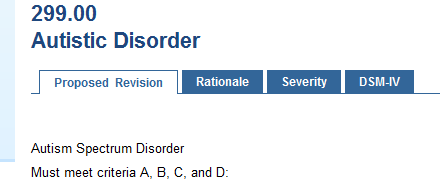
"299.00 Autistic Disorder                   Revised January 26, 2011


Autism Spectrum Disorder
Must meet criteria A, B, C, and D:
A.    Persistent deficits in social communication and social interaction across contexts, not accounted for by general developmental delays, and manifest by all 3 of the following:
1.     Deficits in social-emotional reciprocity; ranging from abnormal social approach and failure of normal back and forth conversation through reduced sharing of interests, emotions, and affect and response to total lack of initiation of social interaction,
2.     Deficits in nonverbal communicative behaviors used for social interaction; ranging from poorly integrated- verbal and nonverbal communication, through abnormalities in eye contact and body-language, or deficits in understanding and use of nonverbal communication, to total lack of facial expression or gestures.
3.     Deficits in developing and maintaining relationships, appropriate to developmental level (beyond those with caregivers); ranging from difficulties adjusting behavior to suit different social contexts through difficulties in sharing imaginative play and  in making friends  to an apparent absence of interest in people
B.    Restricted, repetitive patterns of behavior, interests, or activities as manifested by at least two of  the following:
1.     Stereotyped or repetitive speech, motor movements, or use of objects; (such as simple motor stereotypies, echolalia, repetitive use of objects, or idiosyncratic phrases). 
2.     Excessive adherence to routines, ritualized patterns of verbal or nonverbal behavior, or excessive resistance to change; (such as motoric rituals, insistence on same route or food, repetitive questioning or extreme distress at small changes).
3.     Highly restricted, fixated interests that are abnormal in intensity or focus; (such as strong attachment to or preoccupation with unusual objects, excessively circumscribed or perseverative interests).
4.     Hyper-or hypo-reactivity to sensory input or unusual interest in sensory aspects of environment; (such as apparent indifference to pain/heat/cold, adverse response to specific sounds or textures, excessive smelling or touching of objects, fascination with lights or spinning objects).
C.    Symptoms must be present in early childhood (but may not become fully manifest until social demands exceed limited capacities)
D.         Symptoms together limit and impair everyday functioning."

Will some well known, self described, autism self advocates lose their autism diagnosis when the DSM-5 is published?  Can persons capable of raising a family, performing in rock bands,  driving land rovers, running  successful businesses, serving on the boards and committees of organizations such as ASAN, Autism Speaks and the IACC, graduating with university degrees, appearing before high appellate courts and government committees, publishing books, conducting research, and appearing in print and broadcast media interviews truly be considered to be limited and impaired in their everyday functioning? Will ANY members of the ASAN Board of Directors be considered to be limited and impaired in their everyday functioning?

Look for some intense reaction to the limited and impaired everyday functioning requirement.  Do not be surprised to see a high pressure campaign to eliminate criteria D.

Posted in , , , , , , , , |

Search

Swedish Greys - a WordPress theme from Nordic Themepark. Converted by LiteThemes.com.