Education and Early Childhood Development Minister Jody Carr
EECD/NBACL Event Focus on Inclusion: Walking in our shoes.
Minister Carr spoke for 40 minutes, repeating the word
inclusion 30 - 40 times but never mentioning evidence based
accommodation of individual needs and challenges
Premier David Alward's government has transferred control over New Brunswick education policies and practices to the NB Association for Community Living. The NBACL is, beyond doubt, an organization of people with good intentions committed to improving the lives of those with intellectual challenges. I wish , as the father of a son with severe autism disorder and profound developmental delays I could support them. Unfortunately the NBACL, and its federal counterpart the CACL, have subscribed for decades to a philosophical, non-evidence based, belief that
all children's best interests are served, protected and accommodated by placement in a regular classroom. Alternative learning arrangements are demonized as "
segregation" when in fact such arrangements constitute evidence based accommodation of disabilities that some children, including my son with severe autistic disorder and profound developmental delays, need in order to gain access to a real education.
In handing control over the education of children with disability challenges to NBACL the Alward government is acting in defiance of its obligation to ensure that education decision making represent the best interests of children founded on evidence. It has placed many children with autism and other severe disability challenges at risk of being deprived of meaningful access to a real education, at risk of suffering mental and physical harm and at risk of being charged with criminal offences. The Alward government has sacrificed some children with autism disorders and other disabilities to a fairy tale, one that is known to be untrue by many teachers, education assistants and parents.
In handing control over education of children with disability challenges to NBACL the Alward government has abandoned democratic principles by surrendering one of government's most important responsibilities to an outside organization unaccountable to voters. Equally concerning is the fact that the NBACL does not subscribe to modern, evidence based approaches to educating children with disabilities.
The NBACL adheres to one philosophical principle which it places above the best interests of individual students and which ignores the government's existing
Inclusive Education Definition policy which requires education
decision making based on the individual needs of the student and founded on evidence (not simplistic extreme inclusion philosophy) ... needs which in some cases, such as my severely autistic son, require education outside the regular classroom.
In any public discussion by NBACL reps of the Inclusive Education Definition no mention is made of the stipulation that inclusive education decision making is premised on individual student needs based on an a foundation of evidence requirement. Nor is any mention made of the
fact that students with special challenges, autistic students in particular, in some instances very young, grade school students, are sent home from school when they can not function in NBACL inclusive classrooms.
My son is severely autistic with profound developmental delays. He has been well accommodated in Fredericton schools since he was removed from the regular classroom at our request. He was overwhelmed in the regular classroom and came home each day with bite marks on his hands until he was removed to an alternate, individualized instruction area where he worked with an autism trained Education Aide.
Some children for whom the regular classroom is not the answer are not as fortunate though; some are expelled from NB schools, sometimes under police escort, and some are charged with assault when their behavior, their inability to exist and function in the NBACL dominated school system results. It is always the child who is blamed never the ridiculously simple, non evidence based, unthinking philosophy of the NBACL which is forced on parents, education assistants, teachers, resource teachers and education department officials who must fall in line and repeat the NBACL belief in extreme, everyone in the regular classroom fairy tale.
The children who are sent home and in some cases charged with criminal offences are powerful evidence that the simplistic everybody in the mainstream classroom philosophy is a failure that has hurt some children and impedes their access to a meaningful education contrary to the Education Act, the official Definition of Inclusive Education and contrary to principles enunciated in the Moore decision of the Supreme Court of Canada.
New Brunswick Inclusive Education Definition
The New Brunswick government
Inclusive Education Definition resulted from two inclusive education reviews: the MacKay and Ministerial Committee reviews. Both were initiated by the Lord government although the Ministerial Committee review continued under the Graham government during which time the Inclusive Education definition, after years of consultation with a wide range of stakeholders, was concluded. I attended throughout both proceedings as an Autism Society New Brunswick representative, and advocated, over the persistent opposition of NBACL representatives, for an evidence based approach to the individual education needs of students. Those principles are set out throughout the Inclusive Education definition but particularly in the vision statement, the student centered principles and the accommodation sections (underlining added for emphasis):
"Inclusive Education
I. Vision
An evolving and systemic model of inclusive education where all children reach their full learning potential and decisions are based on the individual needs of the student and founded on evidence
III. Overarching Principles
The provision of inclusive public education is based on three complementary principles:
(1) public education is universal - the provincial curriculum is provided equitably to all students and this is done in an inclusive, common learning environment shared among age-appropriate, neighbourhood peers;
(2) public education is individualized - the success of each student depends on the degree to which education is based on the student’s best interests and responds to his or her strengths and needs; and
(3) public education is flexible and responsive to change.
Recognizing that every student can learn, the personnel of the New Brunswick public education system will provide a quality inclusive education to each student ensuring that:
Student-centered
1. all actions pertaining to a student are guided by the best interest of the student as determined through competent examination of the available evidence;
2. all students are respected as individuals. Their strengths, abilities and diverse learning needs are recognized as their foundation for learning and their learning challenges are identified, understood and accommodated;
3. all students have the right to learn in a positive learning environment;
IV. Accommodation
Accommodation means changing learning conditions to meet student needs rather than requiring students to fit system needs. Based on analysis, student needs may be met through individual accommodation or, in some cases, through universal responses that meet the individual student’s needs as well as those of other students.
The NBACL now determines education policy and indoctrinates NB teachers and educators but it ignores the principles of evidence based accommodation of individual students and insists on regular classroom placement for all students regardless of needs. Some may dispute these points but they are derived from repeated public statements:
2012 - David Alward's Admission That Community Living Association Sets Policy and Indoctrinates Senior Government Officials
New Brunswick Premier David Alward has publicly acknowledged the role of the New Brunswick Association for Community Living related organizations in setting inclusion and disability policy in New Brunswick as was made clear on the community living organizations' IRIS site. IRIS is the Institute for Research and Development and Inclusion in Society. It purports to be the "research" branch of Community Living Assocations across Canada. The IRIS board of directors consists of present and former Community Living Association officials from accross Canada including former NBACL official Lorraine Silliphant.
In February 2012 IRIS spent a week indoctrinating high ranking New Brunswick education officials including Deputy Ministers and Assistant Deputy Ministers in the Community Living Association philosophy based policies of full mainstream classroom inclusion as was bragged about on the IRIS web site:
"Premier Alward of New Brunswick acknowledges IRIS’ ‘Policy Making for Inclusion – Leadership Development Program’
New Brunswick Premier David Alward issued a letter Friday February 4th to all participants in the ‘Policy Making for Inclusion – Leadership Development Program’ that will be delivered in Fredericton by IRIS February 6-10 to senior officials with the Government of New Brunswick. The program is designed to assist policy makers achieve the government’s platform commitment to “enable New Brunswickers with disabilities to actively participate in all aspects of society and take their rightful place as full citizens.” With Deputy Ministers, Assistant Deputy Ministers, Human Resources Directors and Policy/Program Directors from across government participating in the week-long series of leadership development workshops, major strides will be taken towards creating a public service in New Brunswick ready and able to deliver on the government commitment to people with disabilities. In his letter, Premier Alward thanked The Institute “for developing this program to inform our public servants on the latest research on disability and inclusion…” A core resource for the program is the guide to Disability and Inclusion Based Policy Analysis just published by The Institute."
2013 - NBACL Trains Principals and Teachers"25 FEB 2013 11:00PM
SCHOOLS AND COMMUNITY LIVING ASSOCIATION PARTNER UP
CAROLYN THOMPSON
TELEGRAPH-JOURNAL
SAINT JOHN – Schools in southern New Brunswick are seeking support from the New Brunswick Association for Community Living in training principals and teachers on inclusive education approaches.Shana Soucy, manager of inclusive education for the association, said research has shown that without leaders who champion inclusive education, schools have a more difficult time implementing policies to make learning accessible to all students.
“I think we are doing a lot better with having the kids in the classroom, but are they really included in the lessons or are they just sitting there. We don’t want the segregation in the classroom, we want them to be included in the lesson,” she said."
NBACL Manager of Inclusive Education Shana Soucy identified problems, with inclusive education in New Brunswick, on the NBACL Blog site:
Even though Bill 85 was introduced in 1986 stating the full participation of all students in all aspects of school and community life, without regard to their disability or difficulty, we are still coming across many issues regarding exclusion:
- Segregated classrooms and segregated programs across schools in New Brunswick
- Modifications and accommodations are not being properly done to students’ lessons as noted in their Special Education Plans in order for them to have success in school
- Some students are being excluded from school activities (ie: field trips)
- Students are not only excluded from the regular classroom, they are not able to have lunch in the school cafeteria, instead, having their lunch with other students with a disability and Educational Assistants in the Resource room of the school
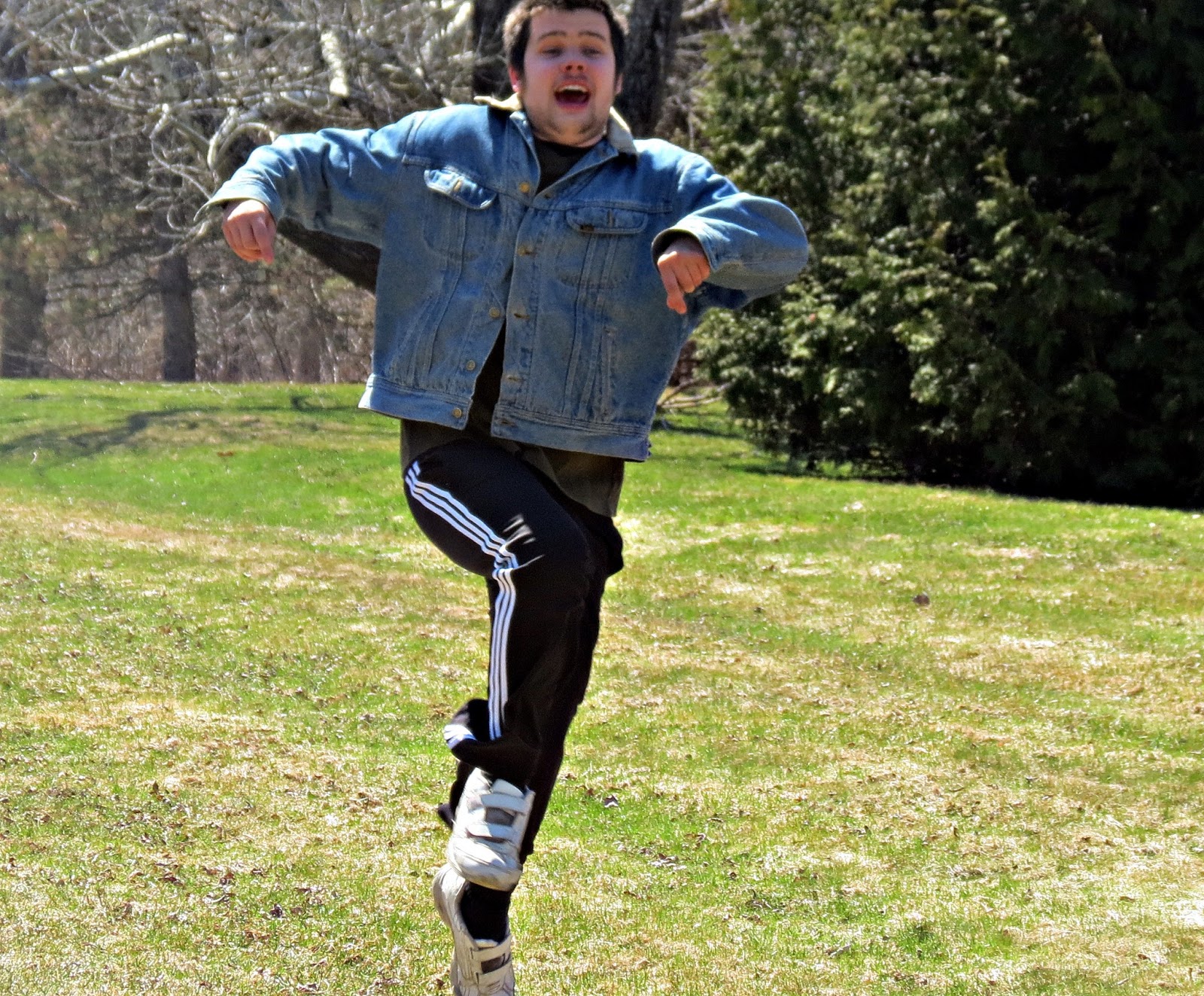
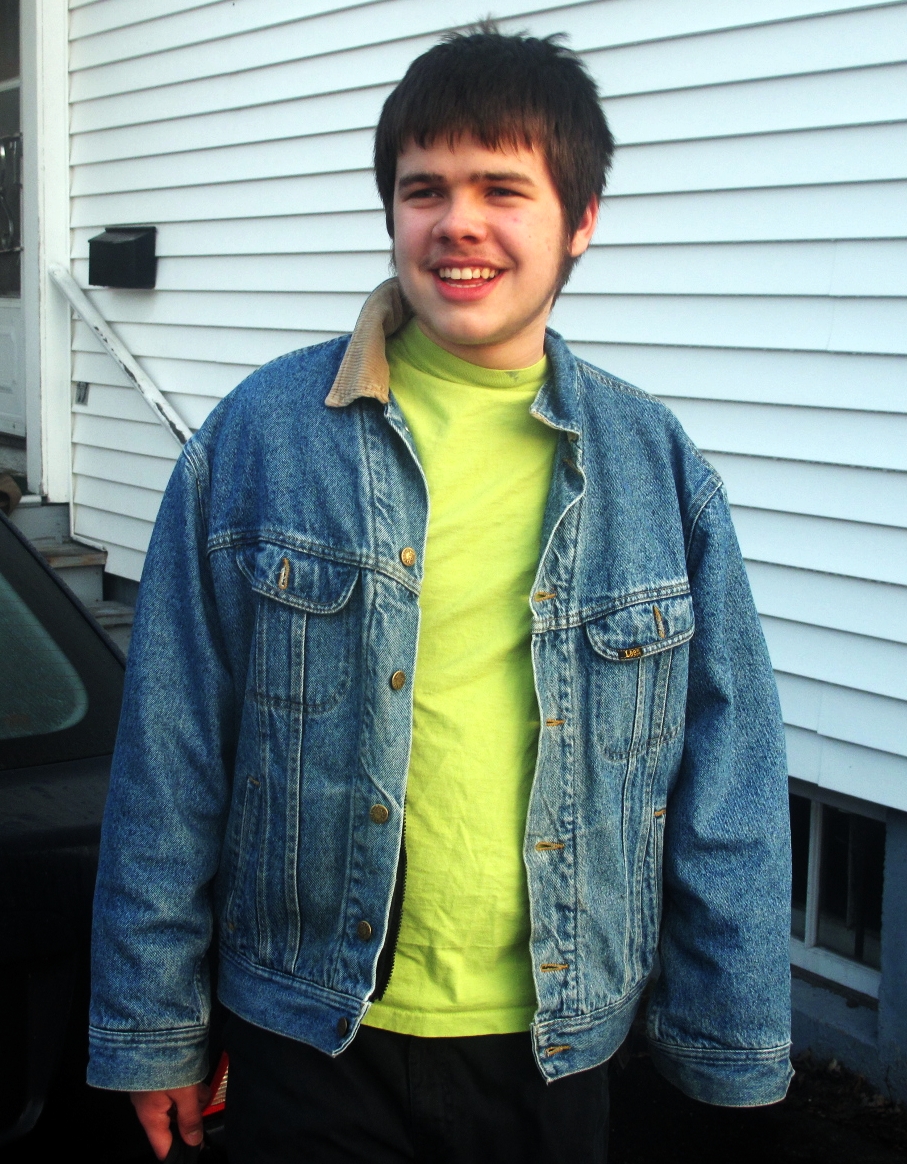
NBACL Inclusve Education Manager Soucy's comments about the Resource room are an insult to students like my son who starts his day and has lunch in the resource room and enjoys tremendously his time at the Resource Centre at Leo Hayes HS. Ms. Soucy's issues with Resource Centres are not my son's issues. Following is a picture of my son on St. Patrick's Day, March 17 2011 as he prepared to leave for school to start his day at the LHHS resource center. He does not feel like he is being excluded or segregated at all. He is fact being accommodated and enjoys his learning experience:
My happy, smiling son Conor can't wait to get to LHHS with a
resource center for some purposes and individual environments
for his ABA based learning. He also uses resources such as the
gym, library, and swimming pool in common with all students.
For Conor these arrangements represent accommodation not segregation.
Contrary to Ms Soucy's non evidence, philosophy based, beliefs Conor loves his time at the resource centre and his so called "segregated" individualized, evidence based, ABA instruction. Each evening he packs his lunch bag, places it in his school bag and when he gets up places it in front of the door to make sure it accompanies him to school. These resources have been vital accommodations of his needs as a student with severe autistic disorder and profound developmental delays. NBACL has clearly targeted for closure resource centers and individual areas of instruction in NB schools. I am very concerned that the fundamental ignorance of the NBACL adherents will deprive my son, and others whose needs are accommodated outside the regular classroom of these very valuable accommodations of their individual needs. Imposition of NBACL Icon Gordon Porter's Simplistic, Extreme Inclusion Philosophy on Department of Education and Early Childhood Development
Even without the indoctrination of high ranking government officials in a week long
inclusion training/indoctrination session based on Community Living policies, and even without government contracting out "disablity" training of teachers to the NBACL on an ongoing basis, NBACL has exercised a dominant role in the current NB government. Gordon Porter, an icon of the NBACL and federal CACL organizations, was a member of the Alward transition advisory team and subsequently conducted, together with NBCLA director Angela Aucoin, yet another inclusion review which was not conducted objectively or transparently and simply reflects Mr. Porter's philosophy as stated by him during a Newfoundland appearance and reported in a Western Star article by Diane Crocker:
"Inclusion in the classroom ‘simple,’ says educator: CORNER BROOK — Gordon Porter believes inclusion is the most natural thing in the world. The educator and director of Inclusive Education Initiatives presented a session on inclusive education at the Greenwood Inn and Suites on Thursday. Porter, who is also the editor of the Inclusive Education Canada website inclusiveeducation.ca, spoke to parents, educators and agency professionals who deal with children with special needs at the pre-conference for the Newfoundland and Labrador Association for Community Living Conference taking place in the city today and Saturday. The session was sponsored by the Community Inclusion Initiative.
Porter’s session revolved around the theme of parents and teachers working together to make inclusion work.“It means kids go to their neighbourhood schools with kids their own age in regular classes,” said Porter.“If you’re seven years, old you go to the school just down the street. You go in a class with other seven-year-olds, and you’re supported if you have extra needs. “It’s so simple, it’s that simple,” said Porter."
Mr. Porter will forever cling to his belief that inclusion is simple if you just dump everyone in the regular classroom regardless of their needs. There is nothing simple about autism though and I defy anyone to point to an informed source that would say there is. As the parent of a severely autistic child with profound developmental delays, sensory issues and, like many autistic children, capable of engaging in serious self-injury when overwhelmed I can not allow myself to wallow in such ignorance.
The new DSM5 autism spectrum disorder criterion B expressly recognizes highly restricted, fixated interests, excessive resistance to change, abnormal in intensity or focus, hyper-or-hypo-reactivity to sensory aspects of environment, factors which, for some students with autism make the regular classroom an obstacle to learning and a risk to the child's safety:

Movie theater chains have recognized autism challenges and realities by trying to present sensory friendly showings of some movies. Self-injurious behavior, (such as head banging and .. hand biting), and responsive (not planned) aggression to others, are recognized as a common problem for many with autism disorders. The appropriate, evidence based approach to dealing with such issues is to provide a continuum of alternative learning arrangements, meaningful learning and functioning with the environment selected and individualized assessments of students skills and abilities to function within the setting selected, as described on the web site of the University of North Carolina TEACCH program which has substantial influence in academic and professional autism circles:
- The TEACCH program recognizes the important value of preparing all persons with autism for successful functioning within society. Each person with autism should be taught with the goal of successful functioning with as few restrictions as is possible.
- Decisions about including children with autism into fully integrated settings must be made consistent with the principle of the "least restrictive environment" as a guiding principle. No person with autism should be unnecessarily or inappropriately denied access to meaningful educational activities. However, it should be noted that the concept of least restrictive environment requires that appropriate learning take place. Placement decisions also require that students be capable of meaningful learning and functioning within the setting selected.
- Activities which are inclusive for children with autism should be offered based on an individual assessment of the child's skills and abilities to function and participate in the setting. Inclusion activities are appropriate only when preceded by adequate assessment and pre-placement preparations including appropriate training. Inclusion activities typically need to be supported by professionals trained in autism who can provide assistance and objective evaluation of the appropriateness of the activity.
- Inclusion should never replace a full continuum of service delivery, with different students with autism falling across the full spectrum. Full inclusion should be offered to all persons with autism who are capable of success in fully integrated settings. Partial inclusion is expected to be appropriate for other clients with autism. And special classes and schools should be retained as an option for those students with autism for whom these settings are the most meaningful and appropriate.
Extreme inclusion is not simple, those who truly believe it is do not have actual first hand knowledge of an overwhelmed autistic child who bites his hand in one of Mr. Porter's inclusive classrooms, or one who reacts to the stresses of school and is sent home under police escort; in some instances to face criminal charges. Inclusion may be simple for Mr. Porter but the simple truth is that he just ignores the evidence, all the evidence, any evidence which contradicts his cherished, fairy tale belief that the regular classroom solves all problems, even evidence of physical and mental harm that results from imposition of extreme inclusion policies on all students regardless of their needs.
At a Fredericton session during the Porter-Aucoin review discussion focused on integrating early autism intervention services into a smooth transition into the school system. ASNB was not invited to the Porter-Aucoin inclusion review session even though it was our advocacy that resulted in the establishment in NB of evidence based early autism intervention AND in the training of 4-500 education assistants and resource teachers at the UNB-CEL Autism Training program (also established in response to our ASNB parent advocacy) a program recognized by the Association for Science in Autism Treatment as a Canadian leader in provision of evidence based intervention for autistic children.
I became aware of the meeting and asked to be able to attend. The discussion went around the table and when it came to me and I tried to speak for the first time I was told by the person conducting the session that they wanted someone else to be given a chance to speak. I did not understand her statement since I had not addressed the group but I did not object. The discussion went around the table again and when I tried again to speak I was again told that they wanted others to be given a chance to speak. I had said nothing during the discussion. I asked if they wished me to leave and was told no and given a chance to speak although nothing I said was reflected in the report that was issued by Porter-Aucoin.
As an ASNB rep I advocated persistently for evidence based accommodation of autistic students including those who required learning outside the regular classroom. During the MacKay review Mr. Porter grew visibly annoyed with me and another ASNB rep Dawn Bowie because of our position. Mr. Porter informed us that "you people should be thankful for what you have". I have never doubted since that day that Mr. Porter's attitude toward educating children with disabilities, even children with autism, a subject with which I and Mrs. Bowie were much more learned and experienced, must conform to his everybody in the classroom beliefs. Neither Mr. Porter, nor NBACL paid officers or representatives have ever deviated one iota from his fanatical obsession with the regular classroom.
NBACL Dominance in the Alward-Carr GovernmentNBACL domination of the Department of Education and Early Childhood Development is clear and indisputable. Apart from Alward transition adviser Gordon Porter, NBACL Official Krista Carr is the wife of Early Education and Childhood Development Minister Jody Carr. Minister Carr's brother Jack Carr, also a member of the governing Alward Conservatives, is a former NBACL employee.
Danny Soucy is the Minister
of Post-Secondary Education, Training and Labour and worked for both the New Brunswick Association for Community Living Inc. and the Canadian Association for Community Living from 1988 to his election in 2010. Teachers who are most compliant with NBACL inclusion beliefs receive awards handed out by NBACL officials.
No one openly questions the philosophically based, non evidence based, policies of the NBACL which sets the Alward government's education policies. Teachers, teacher aides/education assistants and other school personnel have told me off the record for many years, including during the MacKay and Ministerial Committee reviews that they sympathize with my concerns about accommodation of some children with autism, and other students who need an alternative place of learning, but they are unable to speak out. The message is clear, those who conform to NBACL extreme inclusion doctrine will receive awards handed out periodically by NBACL, those who don't ... well they have no choice but to conform.
Conclusion:
As a lawyer I have represented some students on the autism spectrum who have not been accommodated in the everybody in the classroom fantasy of the current Department of Education/NBACL administration. Some have suffered meltdowns for which they were blamed notwithstanding their known autism challenges. Some have been sent home under police escort and some have faced criminal charges.
The Autism Society of New Brunswick advocated during the MacKay and Ministerial Committee inclusion reviews for an evidence based approach to inclusive education which would see alternative learning arrangements for those who needed them.
In the current administration philosophy trumps evidence based accommodation of individual needs. Some students with autism disorders and other severe learning challenges are paying the price.