Showing posts with label autism. Show all posts

Hemispherectomy: Cut My Son's Brain In Half? No Way .... Unless


I am not a neurologist, neurosurgeon or medical doctor of any kind.  I am not a psychologist or a certified behavior analyst.  I am a lawyer and a father of two sons one of whom has a severe autism disorder, profound developmental delays and ... in recent years has suffered a number of seizures including absence seizures and grand mal or tonic-clonic seizures.  He also suffered a life threatening adverse reaction to one of his anti-seizure medications.

With all that I can still not even begin to contemplate, with all the debates and lack of scientific confirmation of cause or cure that exists in the autism literature I have read over the past 15 years, the thought of surgeons cutting my son's brain in half. I am absolutely NOT second guessing the parents who have approved such surgery for their children.  I assume their children's seizures are much worse and much more frequent than what my son has endured. I believe the process is a last resort and is considered when severe seizures are identified as resulting from a specific location in one hemisphere of the brain. To those whose children have received a hemispherectomy I wish their children continued and total recovery and life improvement.

Apart from the kick to the groin that results from even contemplating such a remedy I am unsure from what I have read that the science of this radical procedure is solid.  I am aware that there are reported instances of success, and confirming studies,  as set out in the NBC News article "Taking out half a kid's brain can be best option to stop seizures, research confirms".  On the other hand there are also doubts about the process as set out in the Medpage Today article "Outcomes Mixed for Brain Surgery in Epilepsy".

I am not pretending to have any expertise whatsoever in assessing this medical procedure to deal with epilepsy.  I have advocated for many years for evidence based interventions for autism disorders because of my son's autism and have looked for the most authoritative guidance from genuine autism experts to do so.  I am simply trying to come to an understanding of epileptic seizures and possible treatments and came across this information about Hemispherectomy, literally surgery to remove half of a child's brain.  As a reader can probably tell, I am surprised, very surprised that such a procedure exists today and I understand that other people have faced these serious challenges before with the guidance of medical experts.  

If my son's condition worsens perhaps I would have to get over it and contemplate this option. Right now all I can say is no way! But .... I know I have probably not seen my son endure what other parents have seen their children endure.  I hope I am never forced by circumstances to make such a decision in my son's case and I admire the love for their children and the courage of the parents who have had to make such decisions. 

The Hemispherectomy Foundation web site is available to provide the information, child and family impact stories, and balanced perspective that are lacking in my emotional reaction to learning of this process. Personally I will continue to read more on this important subject.  If the day ever arrives that this procedure is recommended and necessary to help my son ... I hope the science is clear and I hope I have the courage to proceed with his best interests in mind.

Posted in , , , , |

Children's Hospital of Eastern Ontario (CHEO) Writes Off Child With Autism AND Global Developmental Delay (Intellectual Disability)


CHEO: No Teddy Bears & No Autism Program 
for Severely Challenged Children 

The Children's Hospital of Eastern Ontario has been added as a respondent in a human rights proceeding, and accused of discrimination, after it kicked an autistic child with global developmental delay, severe intellectual disability, out of an early intervention program.

In an Ottawa Citizen article Don Butler reported:

"CHEO declined to comment specifically on the case Thursday. But in an email, it said the hospital’s care providers are “incredibly committed to the well-being of kids and would never discriminate against a child because of a disability. “Our clinicians have to make difficult decisions about the appropriate care for each child, and they always strive to base their decisions on the child’s unique needs and best interests.” The only reason a child would be discharged from the intensive behavioural intervention program, the hospital said, “is if the treatment were not working for him or her.

The CHEO did not indicate what "the appropriate care" would be for a child with autism and global developmental delay OTHER THAN early intervention behavioural intervention.  It would be nice if the health "care" providers of the CHEO could indicate what other care was "appropriate" for this or any other child with autism and severe intellectual disability.

In the absence of any indication as to what other care would be of assistance to a child with autism and GDD, in lieu of early intervention,  the only reasonable conclusion is that the alleged health care providers of the CHEO have simply written such children off as unworthy of assistance.  

Posted in , , , , , |

SFARI Highlights Serious Risk of Epilepsy for Teens with Autism and Intellectual Disability


"Children with autism who are older than 13 years and have low intelligence are at the greatest risk of having epilepsy, says one of the largest epidemiological studies on the issue to date1Children are typically diagnosed with epilepsy after having at least two seizures — uncontrolled surges of electrical activity in the brain. About 2 percent of the general population has epilepsy2. Most studies peg its prevalence among people with autism at 30 percent.
The new study, published 4 July in PLoS One, breaks down this prevalence by age. It finds that among children with autism, up to 12.5 percent of children aged 2 to 17 have epilepsy. The rate is largely driven by epilepsy in children aged 13 to 17, who have more than double that prevalence. The study also found that low intelligence — defined as having an intelligence quotient (IQ) below 70 — is associated with a cluster of symptoms seen in people who have both epilepsy and autism. The symptoms include difficulty with daily living, poor motor skills and language ability, regression and social impairment."
SFARI (Simons Foundation Autism Research Initiative), Risk of epilepsy in autism tied to age, intelligence, Laura Geggel, August 19, 2013

The information in the SFARI article above helps inform the public about a study and an issue of great importance, one that should be brought to the attention of parents, family doctors and pediatricians and clinical psychologists - the substantial numbers of persons with autism, intellectual disability, epilepsy. and the adolescent years during which many with autism and ID first endure epileptic seizures.

The study itself could be a capsule summary of my son's disorders during his first 17 years of life.  Diagnosed at age 2 (literally the day after his second birthday) , after several months of tests, Conor suffers from Intellectual Disability the ultimae taboo in autism world discussions.  Together autism and intellectual disability increase dramatically the chances of developing epilepsy.  As the article and study it reports indicate adolescence is an age when epilepsy appears for many with autism and intellectual disability.  That is exactly what happened with our son Conor.

Conor's first Grand Mal seizure, as I reported on November 17, 2012, (No Autism. Today, Conor's Grand Mal Seizure Scared The Hell Out Of Me) literally shook our world. We had reported what we thought were seizures to Conor's pediatrician 18-24 months before.  He would suddenly stare off looking away or close his eyes as though he was in pain. His pediatrician agreed they were probably seizures but indicated medication was probably not a good idea since there was no falling involved in his seizures.  On November 17 things changed dramatically with Conor's first Grand Mal.  He would later suffer a second Grand Mal,  and shortly thereafter a life threatening adverse medication reaction, which I have also reported on this blog.

Our experience led me to believe that pediatricians and other doctors, as well as clinical psychologists, should inform parents and advise them to be on the look out for the development of seizure activity in their autistic children.  Hopefully this major study reported by SFARI and the prestige of the Simons Foundation Autism Research Initiative will encourage professionals  to inform and educate parents of autistic children particularly those with intellectual disability to be on the lookout for seizure activity and how to recognize them.  They may also want to direct them to Silently Seizing written by Caren Haines, RN and mother of an autistic son who suffered from seizures.  The book pulls no punches in talking about the damage that can occur  from seizures and would be an honest introduction to the seizure activity and its risks. 

Posted in , , , , , , |

OTARC Panel: Dr. Giacomo Vivanti: Does Severe Autism Cause Intellectual Disability?

Excellent panel discussion by the La Trobe University Olga Tennison Autism Research Centre (OTARC) with Dr. Giacomo Vivanti, Dr. Cheryl Dissanjake and Dr. Cynthia Zierhut.  The panel comments on the cultural representation of autism as genius in movies such as Rain Man and television series such as the Big Bang theory. Dr. Vivanti talks about autism research tendency to focus on high functioning autism perceived by many autism researchers to constitute "pure" autism research.  He calls this bias into question as non evidence based,  circular reasoning. There is no legitimate basis to separate autism and intellectual disability as "comorbidity".  

Dr. Vivanti's recent paper, Intellectual development in autism spectrum disorders: new insights from longitudinal studies,  has looked at the possibility that severe autism itself causes intellectual disability an hypothesis which itself is controversial.

Posted in , , , , , , , , |

Conor Countdown Continues In Support of FLEXIBLE, EVIDENCE BASED Inclusion


The Conor Countdown continues, as Conor gets up each day at 6 am and changes the number reflecting the number of days until school resumes.

My son Conor, and his autism disorder disability,  have been well accommodated in schools here in Fredericton, New Brunswick, Canada.  He has benefited both from the assistance of education aides and resource teachers trained in the UNB-CEL Autism program and by placement, at our request, outside the regular classroom for his ABA based instruction.

 His placement is not segregation in the sense of the racial segregation which once prevailed in the American south.  His placement reflects the fact that Conor's autism based sensory sensitivities and need for predictable routine, coupled with his individualized learning style and instruction methods require a quieter learning environment. 

In the regular classroom, early in Conor's education,  he bit his hands every single day until he was removed to a quieter location where the self injurious biting ceased. Now in high school his individualized instruction continues but he has many, many opportunities for socialization at the Leo Hayes High School Resource Centre with other students with special needs, in common areas and activities like school outings, visits to the cafeteria and ... Conor's favorite by far ... in weekly visits to the Nashwaaksis Middle School swimming pool. 

Conor loves his flexible, evidence based schooling so much that the summer, with no school, is a difficult time for him.  We do our best to help him during this period and Conor does his best to help himself.  One of the activities that helps him get through the summer break is the "Countdown".  Each day, every day, at 6 am Conor gets up and changes the number on his board under the question "How Many Days Until School?"  He can see the number getting smaller each day, he can take steps each day to make the number smaller reducing his anxiety and frustration.

Conor's self injurious biting while placed in the regular classroom was a vote against the extreme, non evidence based "regular classroom for all students" philosophy. Now, during the school year Conor packs his lunch bag every night and puts it in front of the side door to the driveway and Dad's car. During the summer Conor does his "How many days until School" countdown.  Both activities are strong compelling statements from Conor in support of the flexible, evidence based, inclusive education he has received at school since being removed from the regular classroom.

Posted in , , , , , , , , , |

Autism`s 40% With Intellectual Disability? Auti$m $peak$ Doesn't See YOU, Doesn't Speak For YOU!


Autism Speaks has done much to create publicity around the word autism, the color blue, puzzle pieces and ... some very talented, high functioning individuals with autism diagnoses like Alex Plank and J. E. Robison.  In terms of its public statements and presentations though it does little to nothing to  raise awareness about one very basic fact: autism has a very close relationship with intellectual disability to the extent that 40% of persons with autism spectrum diagnoses (DSM-IV) also have intellectual disability. 

Prior to the DSM-IV and prior to the addition of PDD-NOS and Aspergers persons with intellectual disability constituted the vast majority of persons with autistic disorder.  Autism Speaks has reluctantly acknowledged that 40% of persons with autism have intellectual disability but does not reflect their existence in their press releases.  Autism Speaks conflicted attitude toward those with autism and intellectual disability was illustrated vividly in the recent Drake and J. Cole lyrics uproar when Autism Speaks defended persons with autism but not those with autism and intellectual disability. Instead of criticizing the rappers for their derogatory reference  to persons as “autistic, retarded." Autism Speaks went further and argued that in fact persons with autism are very successful and talented. No mention was made in the Autism Speaks press release of the 40% of the autism spectrum who are intellectually disabled even though the words "mentally retarded." have been replaced by the words intellectually disabled.  

Autism Speaks chose not to stand up for the intellectually disabled members of the "àutism community" even though they were  expressly  maligned in the original lyrics:


"Lyrics from the recently released song “Jodeci Freestyle” from hip hop artists Drake and J.Cole have many in the autism community up in arms. The song, which was released last month and is now getting airplay, contains the following lyric by J. Cole: “I’m artistic, you n----s is autistic, retarded." 

These lyrics are offensive and perpetuate negative stereotypes. There are many inspiring individuals with autism and other disabilities who have achieved great success across a variety of artforms, including music. We encourage J. Cole to recognize their talents and learn from the positive example they have set for all of us."

This is not the first time Autism Speaks has chosen to ignore the intellectually disabled 40% while promoting the very, very, very high functioning elite members of the autism spectrum like J. E. Robison and Alex Plank.  There is almost never any mention of the intellectually disabled in promotions and news releases by Autism Speaks or on their web site.  I have previously noted that Autism Speaks has only reluctantly acknowledged the existence of intellectual disability on the About Autism section of its web site burying mention of 40% with ID in the middle of the page, book ended by references to those with high IQs and abilities.

In the "rapper incident" AS went further than just ignoring those with autism and intellectual disability.  They implied that persons with autism, all persons with autism, are in fact talented, successful people.  They were ashamed to mention and defend the 40% with autism and Intellectual Disability.  The rappers have offered sincere apologies and taken steps to address the issue by changing the lyrics.  Rapper J.  Cole even acknowledged the existence of those with severe autism and their families.  By their actions Drake and J. Cole have shown themselves to be ahead, light years ahead of Autism Speaks in caring about ALL persons on the autism spectrum including the 40%  intellectually disabled.  

Posted in , , , , , , , |

Conor's Fredericton Adventures 2013 Part I


Conor & Dad, couple of hosers enjoying the snow, eh?


Conor's Saint John River view clear day, above, not so clear below


Conor helps Dad with a visit at the Chalmers Hospital Acute Care Unit


Conor and Mom head out for  a stroll on the North Riverfront Trail


Conor changes his mind about the strolling part


Conor enjoys a late March snowstorm eh?


Conor isn't the only one who gets to fly along our North Riverfront Trail


The Run Jump Fly Boy lets it all loose on the North Riverfront Trail, Fredericton


Just days after Conor was running, jumping and flying down the trail he was taken by ambulance to the Chalmers Hospital in Fredericton where he spent 6 days in the Intensive Care Unit, and a total of 2 weeks in hospital, as a result of a life threatening adverse reaction to his anti seizure medication. 


Many thanks to the incredible doctors, nurses and staff at the Chalmers Emergency and Intensive Care Units for saving our Conor.


Conor didn't take too long to fully recover and there was no better way to show it than heading out on the trail with Mom and Dad ... where he had to wait from time to time for us to catch up.

Looking forward to lots more fun with Conor on the trail and elsewhere in 2013.  I hope he continues to enjoy the wonderful outdoor environment that Fredericton and friends like the Ospreys shown below offer. 


Posted in , , , , , , |

Sound Advice for Autism Speaks


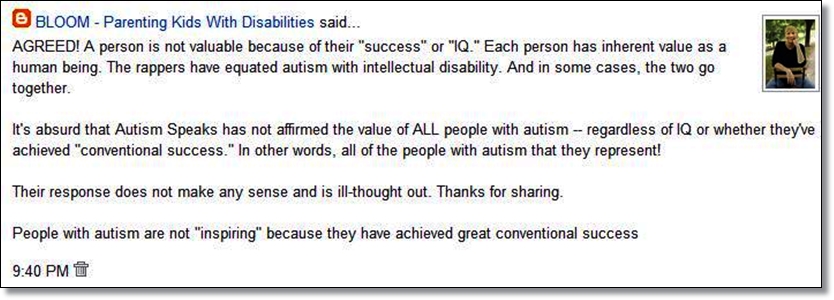
In yesterday's commentary  Autism Speaks Joins Drake And J.Cole In Insulting 40% With Autism AND Intellectual Disability I criticized Autism Speaks for stigmatizing persons with Intellectual Disability, particularly the 40% of persons on the autism spectrum with ID, the 40% that Autism Speaks seldom acknowledges in its promotions and literature.  

I received the comment, posted above, from BLOOM - Parenting Kids With Disabilities editor Louise Kinross that expresses my issue with Autism Speaks' approach to intellectually disabled members of the autism spectrum better than I did. It would do Autism Speaks and the autism community it purports to represent  a great service to give serious consideration to Louise's comment. 

Posted in , , , , |

40% Intellectual Disability In Autism Disorders: Coincidence or Consequence?


I have never subscribed to the assumption that Intellectual Disability is a co-morbidity as described by the authors of a new study examining Intellectual  Disability in Autism: (unrelated in etiology and causality from the ASD itself)  I have been frustrated by the historical tendency of  "autism" researchers to exclude intellectually disabled autistic subjects from their research studies.  I am very disappointed with Dr. Lord, Dr. Swedo, Dr. King and other APA members for their efforts to further the artificial disassociation of Intellectual Disability from Autism Spectrum Disorder (s) in the DSM5.  I have always believed, as the father of a severely autistic son with "profound developmental delay", and contrary to the "autism as strength" ideology of Dr. Laurent Mottron and Michelle Dawson, that autism and intellectual disability are inseparable components of my son's condition. I am very pleased to see reports of a new study, as set out in this brief online paper by the authors of that study, which begins to examine the ID and ASD relationship front on and with complete intellectual honesty.  

I hope that the proof of principle resulting from the study  that "ASD symptom severity contributes to the extent to which the environmental input required to support “typical” brain development can be processed by the individual, so that the risk of developing ID increases as the number and severity of ASD social-communicative impairments increase"  is pursued further and that additional research on this topic is not squelched by the political correctness of those who control autism research funding dollars.

I also hope that researchers study the ID in ASD issue from  different perspectives:  that the ID increases the severity of the ASD symptoms and that ID and ASD are simply different aspects of one condition.   This humble father  does not believe that my son's severe autism symptoms and ID are separate coincidental or "comorbid" conditions.  I am pleased to see these "down under" Austalian researchers joining the ranks of the few with the intellectual honesty and curiousity to study the Intellectual Disability component of autism symptoms and disorders.

Intellectual development in autism spectrum disorders: new insights from longitudinal studies

Giacomo Vivanti1,2*, Josephine Barbaro1Kristelle Hudry1Cheryl Dissanayake1 and Margot Prior1,3
  •   1Olga Tennison Autism Research Centre, School of Psychological Science, La Trobe University, Melbourne, VIC, Australia
  •  2Victorian Autism Specific Early Learning and Care Centre, La Trobe University, Melbourne, VIC, Australia3
  • Melbourne School of Psychological Sciences, University of Melbourne, Melbourne, VIC, Australia
The presence/absence of Intellectual Disability (ID) is considered to be the most critical factor affecting outcomes in individuals with Autism Spectrum Disorders (ASD). However, the question of the specific nature of ID in ASD has received little attention, with the current view being that ID is a comorbid condition (i.e., one that is unrelated in etiology and causality from the ASD itself). Recent advances in developmental neuroscience, highlighting the importance of early exposure to social experiences for cognitive development, support an alternative view; that ID in ASD might emerge as a consequence of severe social-communication deficits on the experience-dependent mechanisms underlying neurocognitive development. We tested this prediction in two independent samples of young children with ASD (Ns = 23 and 60), finding that children with greater ASD severity at an initial assessment were more likely to present with poorer cognitive outcomes at a later assessment, irrespective of initial cognitive level. The results of this proof of principle study suggest that ASD symptom severity contributes to the extent to which the environmental input required to support “typical” brain development can be processed by the individual, so that the risk of developing ID increases as the number and severity of ASD social-communicative impairments increase.

Posted in , , , , , , , , , |

Conor Debunks TWO Autism Myths Eh!

Yesterday was Canada Day and Conor sported his Team Canada shirt to celebrate.  He also debunked not one but TWO autism myths.  Conor has received ABA based intervention at school for 8 years.  Yet, contrary to the myth that ABA causes discomfort and harm to persons with autism disorders,  Conor shows his terrific smiles again ( see also side bar on this blog) debunking that nonsense yet again.  He also debunks the myth that people with autism disorders do not like hugs and his Mom was very happy to assist in the demonstration!


Posted in , , , , , |

Happy Canada Day, Eh!


Canada flag photo by Harold L Doherty, very happy to be a Canadian,  
living in Canada, despite the lack of progress on the national autism front  

Today is Canada Day and I am very happy to be a Canadian living here in Canada.   We can still enjoy living in one of the world's freest countries in the world.  I am happy and thankful that Canada is my home. I am thankful for our freedoms, our beautiful natural environment and our national health care system that generally takes  good care of all Canadians not just those who can afford the very best care. 

Not much positive though can be said on our national autism front, a point that was reinforced by the death this week of former Fredericton MP, national autism champion and all aground great guy Andy Scott.  Andy did succeed in getting autism on the national agenda with his private member's motion M-172 and tried to follow up to push the Harper government to action. Our Prime Minister and his submissive federal health bureaucracy though have done absolutely nothing to advance the cause of Canadians with autism, particularly those with severe autism disorders ... Canadians like my youngest son.   

Notwithstanding lack of autism progress nationally though events of the past year have brought home to me all too forcefully that I am very lucky to be living in this wonderful Canada. When I could not breathe while waiting in an after hours clinic I received immediate care, was sent by ambulance to the emergency clinic of the local hospital and received acute care attention for a week at minimal expense.  When Conor suffered grand mal seizures and an adverse drug reaction he received care for two weeks at the same hospital including 6 days in the intensive care unit where he received the medical attention that saved his life.

My family and I are fortunate to live in Canada even without national level autism effort. 

I will continue to fight on the national autism front with wonderful autism advocates like the members of Medicare for Autism Now! 

In the meantime I wish everyone a very happy Canada Day, eh!

Posted in , , , , , , |

Canada Loses an Autism Champion: Andy Scott Passed This Morning


Andy Scott With A Megaphone Supporting Autism Cause with Andrew Kavchak

Canada has lost an autism champion with the passing this morning of former Fredericton MP Andy Scott.  In a telephone conversation with a friend and fellow autism advocate elsewhere in Canada I once suggested the person contact their federal Member of Parliament.  I was informed that had already been done but there would be a wait before the MP could be seen.  There was some apparent disbelief when I mentioned that I could literally walk across the street to the office of our then MP Andy Scott and if he was in he  would probably see me or any other visitor.  

Andy met with representatives of the Autism Society NB on several occasions and actively pushed for a National Autism Strategy which he ultimately realized with the passage of Motion M-172.  The motion was essentially a commitment in principle with no obligations being undertaken by our federal government but it did help put autism on our national agenda and it was Andy Scott being Andy ... getting done what could get done ... with a view to moving forward further in future.  He continued to advocate for autism as demonstrated in his June 5, 2007 statement in House of Commons:

Autism 

[Table of Contents]

Hon. Andy Scott (Fredericton, Lib.):

Mr. Speaker, it is regrettable that we have seen little action by the government toward implementing a national autism strategy.

It has been more than a year since I introduced Motion No. 172. My private member's motion called for evidence based standards, innovative funding arrangements for diagnosis, treatment and research, and a national surveillance program.

The motion was adopted in good faith and supported by the government. However, it was very disappointing to see no reference to a national autism strategy in the recent budget or any discussion this spring.

Recently, I joined my colleagues from Charlottetown and Sackville—Eastern Shore and Senator Munson at a rally in Halifax that reinforced that there are families with autistic children across Canada who need the government's help.

The Conservatives should move off their default position of jurisdictional excuses, show creativity and compassion and start helping these Canadians.

On a previous blog commentary about Andy I had referenced the National Autism Strategy and quoted from Tali Folkins 2003 Telegraph Journal article:

"Fredericton MP Andy Scott said Saturday he has been lobbying prime- minister-to-be Paul Martin for a federal program to help young children with autism. "I desperately want a national autism strategy - and let me just assure you that Paul Martin knows it," Mr. Scott told supporters at a party celebrating his 10th anniversary as an MP in Fredericton Saturday evening.

Early work by therapists with young autistic children, Mr. Scott said, can make a big difference in their capacity to lead fulfilling lives as adults - and can save money in the long run. But the costs of starting such early intervention programs are high and should be borne directly by Ottawa rather than each individual province, he said. "We have responses and therapies and so on that I genuinely believe can work," he said. "You're going to save millions of dollars over the lifetime of an autistic adult. If you can get in at the front end, you can make enormous progress.

"But it's very expensive, and there's not a lot of stuff being added to Medicare, generally - that's why we have catastrophic drug problems and other things," he said. "In the province of New Brunswick, P.E.I., or even Quebec or Ontario it's very, very expensive. The feds are going to have to step up to the plate." "

Andy Scott fought on behalf of autistic persons in Canada.  He did not achieve all the goals he wanted by any means but he did what was possible in the time he had. Autistic Canadians have lost a champion today.  

Posted in , , , |

Conor Recovery ... For Dad ... Means Walking On The Trail Again

We have been very happy with the excellent care Conor received after his adverse drug reaction. Everyone involved, from our family doctor who saw us very quickly after our concerns arose, immediately advised cutting back on Conor's meds and was at the ICU and pediatric wards as part of his treatment team to the doctors, nurses, technicians, physiotherapists and all staff at the emergency, ICU and pediatric ward teams. All were terrific in ensuring Conor's recovery. Everybody was top notch and we are grateful for their service to our son. 

Each day of progress brought fresh signs and while some work remains overall his progress has been great. This afternoon he and I walked the trail to the Superstore for an OJ treat and return home. The Run Jump Fly boy has not returned ... yet ... but Conor kept a brisk walking pace and Dad was very hard pressed to keep up ... another great sign of Conor's recovery progress.

In the top picture below the white building with yellow trim in the center of the photo is the hospital, the DECH, where Conor was treated a few weeks ago. 
 A long time ago in a universe far, far away.


Posted in , , , , , |

Extremely Grateful


The Intensive Care Unit of the Dr. Everett Chalmers Hospital in Fredericton made a difference for our family.  They saved our son Conor's life after he suffered an adverse reaction to new anti seizure medication.  They gave our son back to us. For that we are, as the CBC caption underneath the audio of my interview in support of the ICU campaign to raise funds for new monitoring equipment put it ... extremely grateful. 

As we understood it Conor's muscles were breaking down and releasing proteins that were very dangerous to his kidneys. The ICU team were monitoring him constantly while flushing the meds out of his system, taking blood samples and other tests and examinations and starting him on the road to recovery.  

Conor spent 6 days in the ICU with his mother beside him where she slept on a cot for the  entire stay.   During those six days the ICU doctors and nurses were reading his vital information in the room he was in and at the large desk area outside the patients' room.  This monitoring equipment is 10 years old and needs replacement.  If you can help the ICU team save lives   please do so by contributing at the Chalmers Foundation

Audiotape of my interview by CBC's Terry Seguin yesterday in support of the campaign to raise funds for new monitoring equipment for the Chalmers' ICU:


Conor at the Chalmers Hospital's Intensive Care Unit 
In the left of the photo above you can see some of the 10 year old 
monitoring equipment that the ICU team used to save Conor's life.


Conor home and happy after his first day back at the swimming pool as part
of his school recreation activities. We asked his school assistant to take him only in to the shallow end but Conor had none of that and went to the deep end, swimming, jumping off the diving board and going up and down the large slide.


Posted in , , , , , |

NBTA Acknowledges Education Department's Obsession With Inclusion Philosophy


The New Brunswick Teachers Association has spoken up ... sort of ... about New Brunswick's extreme inclusion philosophy.  The NBTA to its credit  acknowledges, finally, that inclusion is a philosophy not an educational plan as stated by outgoing NBTA President Heather Smith at a meeting of delegates from around the province.  Smith also acknowledged that the education focus during the past year has been  on the Porter Aucoin Report with all "professional development" focused on inclusive education.  Smith, in a recent Daily Gleaner article by Tara Chislett,  also talks about the need for more resources without identifying any of those resources.  Many autism students who require autism trained education aides do not have them.

Outgoing NBTA President Smith also fails to acknowledge that some students with severe autism and other severe difficulties require accommodation of their disabilities by learning outside the regular classroom. Unfortunately the inclusion extremists have targeted such human rights accommodations as constituting segregation and  are trying to eliminate them. What Smith did not say is that in New Brunswick inclusion is a ridiculously simplistic "everybody benefits from education in the regular classroom" belief.

Although Ms. Smith did not go far enough in her critique of the education philosophy that has ruled the minds of New Brunswick educators and civil servants it is a solid beginning.  At last one voice, other than the Autism Society New Brunswick in its submissions to the MacKay and Ministerial inclusive education reviews, and me personally, has spoken out against the decades old mindset that has provide obstacles to the accommodation of students with severe disability challenges.

"The president of the New Brunswick Teachers’ Association says the Department of Education has focused too much on inclusive education over the last year instead of giving teachers what they need most: an education plan laying out achievement goals.
“One year ago, I stood at this AGM and made the statement that New Brunswick was still without a publicly unveiled education plan,” she told the crowd. “It’s frustrating that I am here making the same statement today. It is quite clear that the education focus this year has been on the Porter Aucoin Report and that all department-led professional development has focused on inclusive education.
“I have a degree in special education and it is my belief that inclusion is an approach, a philosophy, not an educational achievement goal.”
Smith said in addition to a lack of an education plan, schools continue to struggle with not having enough resources as the government continues to cut away at budgets.    ...  “Inclusion’s not an outcome. I’m sorry. It’s a philosophy. And we’ve had that philosophy in our schools since the mid-80s. It’s a great philosophy, we support it if the supports and resources are there so schools can do it effectively.  “But that’s not a plan for education. It’s not."  (Bold added - HLD)

Excerpts from Teachers Say Education Plan Overdue, Daily Gleaner, May 26, 2013 

Posted in , , , , , |

CBC News Misrepresents Autism By Omitting Any Reference to Intellectual Disability


In "The  new definition of autism" CBC News provides detailed descriptions of autism as represented by the five pervasive developmental  disorders in the DSM-IV and the Autism Spectrum Disorder in the now published DSM5.  With one major exception the article is a good summary of autism disorders pre and post DSM5. On another positive note the article expressly references ABA/IEBI as the primary evidence based intervention for autism treatment.  The major exception to this otherwise balanced, thorough article is the failure to mention, while describing conditions commonly associated with autism,  the substantial numbers of  persons with autism who also have an intellectual disability:

"What are some of the symptoms of ASD?

There is no single symptom that would lead to a diagnosis of autism. But someone who shows a number of the following characteristics and behaviours would likely be diagnosed with an ASD:
  • Shows no interest in other people
  • May be interested in people, but does not know how to talk, interact with or relate to them
  • Has difficulty initiating and maintaining a conversation.
  • Is slow developing speech and language skills, which may begin to develop and then be lost, or may never develop fully.
  • Has difficulty interpreting non-verbal communication such as social distance cues, or the use of gestures and facial cues, like smiles, that most of us take for granted.
  • Repeats ritualistic actions such as spinning, rocking, staring, finger flapping, and hitting oneself.
  • Has restricted interests and seemingly odd habits, like focusing obsessively on only one thing, idea or activity.
As well, people with ASD may have secondary problems such as:
  • Neurological disorders including epilepsy.
  • Gastro-intestinal problems.
  • Fine and gross motor deficits.
  • Anxiety and depression.
Children with ASD develop motor, language, cognitive and social skills at different rates from other children their age. For instance, they may be very good at solving math problems but have great difficulty making friends or talking."
The only reference to intellectual or cognitive disabilities in the CBC News article is in the last paragraph above which implies that cognitive skills may develop at different rates in conjunction with other skills and immediately mentions possible strengths such as solving math problems.  This is not by any means a clear and accurate representation of the intellectual disability that is present in large numbers of persons with autism. 
The CDC in the United States has estimated the numbers of persons across the autism spectrum who also have intellectual disability in the range of 41-44%:
  • Data show a similar proportion of children with an ASD also had signs of intellectual disability than in the past, averaging 44% in 2004 and 41% in 2006.
The CDC estimates are consistent with other estimates of the "co-morbidity" of autism and intellectual disability that I have posted links to on this site.

There is no legitimate reason to ignore the large numbers of persons with autism disorders who also have intellectual disabilities.  It is a relationship that should be explored and studied (La Malfa)  not hidden  and stigmatized.

Posted in , , , , , |

Conor Goes For A Swim (and a Dive and a Slide) and Shows Terrific Progress In His Rhabdomyolysis Recovery


Conor home after a great swim adventure;
making terrific progress on his recovery

Conor's autism and profound developmental delay were supplemented by two grand mal seizures between November 2012 and April 2013.  The second seizure occurred two days after he began treatment with the anti seizure medication Lamotrogine.  During the second week of treatment when his dosage was increased from 1 to 2 25 mg tablets a day he began to sleep and medical advice was sought.  The specialists were not available quickly but our family doctor saw us early the next day and advised us to cut back on the dosage which we did.  Later that day though Conor still developed a rash and temperature and went to the emergency ward of the local hospital, the DECH.  He spent 6 days in the Intensive Care Unit and two weeks altogether in the hospital.  Conor's adverse reaction to his medication was diagnosed as Rhabdomyolysis a condition in which the muscles break down and release substances which pose great risk to the kidneys.  But Conor received excellent medical attention and was released to come home where he has continued to make made great progress.

We would like to take some credit for Conor's great recovery but the truth is he has led with his own initiative. Conor was jumping up off the couch even before he had his balance and we had to keep a close watch on him. This week Conor returned to school for part days.  His mobility and balance improved dramatically each day and this morning he went swimming at school for the first time since his hospital stay.  The plan was for Conor to go to the pool and sit in the hot tub.  Conor had none of that.  His aide informs us that instead  Conor walked down the accessibility ramp into the shallow end of the pool. He subsequently went to the  diving board where he jumped into the deep end and swam like a fish.  Conor also made for the giant slide where he climbed to the top and slid down.   

I couldn't have asked for a better present then to learn about Conor's swim adventure today.  6 days in the ICU with 5-6 tubes at a time sticking out of my buddy Conor seem  like a bad dream today.  Our Run Jump Fly Boy was flying today and we are happy, very happy.

Posted in , , , , , , |

Conor's Physiotherapy With CBC's Terry Seguin


Conor is still recovering from Rhabdomyolysis, an adverse reaction to anti-seizure medication, Lamotrogine and needs phsyiotherapy to rebuild his damaged muscles, balance and co-ordination.  Just being home is a huge help for Conor, back home with Mom, Dad, his brother and his familiar routines.  One of those routines has been to get out of bed every morning at 6 am.  If he is awake at 5:30 he stays in bed until 6. That is his routine and Conor has a classic autism need for routine.  When he gets up each morning his routine has also included turning on the television and watching  "CBC Terry Seguin".   

Conor has been sleeping on a living room couch since his return so I could be nearby on our other couch to keep an eye on him in case he was in distress. This morning I was in the adjacent kitchen when I heard some loud walking noises in the living room and went in to find that Conor had walked from the living room to the television to turn on CBC Terry Seguin.  Conor has been very wobbly on his feet and he has a long way to go towards recovery so I was startled to see him at our big screen TV.  I was happy though that he had done so without falling and hurting himself. It was a sure sign of progress in his recovery.  His CBC Terry Seguin television walk demonstrated improvement physically and showed that Conor will not stay down, he will keep walking until he is fully recovered.  Two thumbs up for Conor ... and for Terry Seguin!

Posted in , , , , , , , , , |

Unthinking Autism Guide Shannon Rosa Attacks Autism Parents .... AGAIN.


Shannon  Rosa, with the Twitter help of Seth Mnookin and Dr. Jon Brock is at it again, misrepresenting autism disorders and the state of knowledge about autism causation and of course blaming autism parents fighting for their children for the latest report of a professional caregiver abusing an autistic child because they dare talk honestly about the negative aspects of autism DISORDERS :

"At their worst, negative media-sown autism messages influence people like Greg Simard, who brutally beat a 12-year-old, non-speaking autistic boy in his care. Simard justified his actions by saying of the boy, .... Some autism parents never find their way out of that initial horror and negativity, .... These parents see other autistics writing, speaking, participating in online communities, and their furor increases -- how dare those autistics say good things about autism, when their kids need 24 hour supervision?"

Ms. Rosa's wild, hostile opinions are not substantiated by evidence or professional consensus of any kind but that doesn't stop Mnookin and Brock  from spreading her hateful messages.  In the instant case there is no basis whatsoever to the claim that the media focuses on negative stereotpyes or that it does so because of  bad autism parents.  Temple Grandin is celebrated around the world.  John Elder Robison and son Cubby regularly receive promotion on CNN.  Television series inevitably portray autism in the form of the socially awkward but otherwise brilliant, high functioning techie, geek syndrome as autism. 

Rosa's claim that the abusive caregiver is influenced by the alleged overwhelming dominance of negative media stories is absurd and, once again, based on no evidence whatsoever. An abuser makes a cheap comment in the media and Rosa accepts it as reality because, in her mind, it confirms her negative views of other autism parents who do not share her views. This is no accident.  A mother in Colorado killed her autistic child and stated that she did so because she feared the child was autistic.  Rosa leaped to the attack against autism parents speaking honestly about their children's autism disorders blaming them for the mother's actions. What Rosa bypassed in her attack  was the fact that the prosecution had concluded that the woman was insane and for that reason did not prosecute her. 

I am not going to repeat all of Rosa's misinformation about autism on this site.  Her statements of fact are in fact simply her opinions, opinions that reflect her hostility towards autism parents who fight to improve their childrens' life prospects by speaking honestly in the effort to find autism causes, cures, treatments and services  for their children.  These parents, and I consider myself one of them, do not conform to Rosa's angry .... and flat out silly ... mischaracterizations.

While Rosa is out with her non evidence based rants about autism disorders and parents fighting for their autistic kids here is a bit of autism reality from the New England Journal of Medicine, the kind of stuff Rosa doesn't want the world to know about:

"Genomics, Intellectual Disability, and Autism

"Autism spectrum disorders have been estimated to affect as many as 1 in 100 to 1 in 150 children.4,5 Disorders on the autism spectrum share features of impaired social relationships, impaired language and communication, and repetitive behaviors or a narrow range of interests. Many children with autism spectrum disorders also have intellectual disability, and approximately 75% have lifelong disability requiring substantial social and educational support. Thus, autism and intellectual disability together represent an important health burden in the population and are frequent reasons for referral to genetics and developmental pediatrics clinics for a diagnostic workup."

Prediction: the next similar tragedy that befalls an autistic child will also be blamed by Rosa on other autism parents with whom she disagrees.  Her views will unfortunately be promoted by the Mnookins,  Brocks and other professional and academic Neurodiversity subscribers.  Thinking Persons Guide to Autism? Not even close.

Posted in , , , , , , |

Search

Swedish Greys - a WordPress theme from Nordic Themepark. Converted by LiteThemes.com.